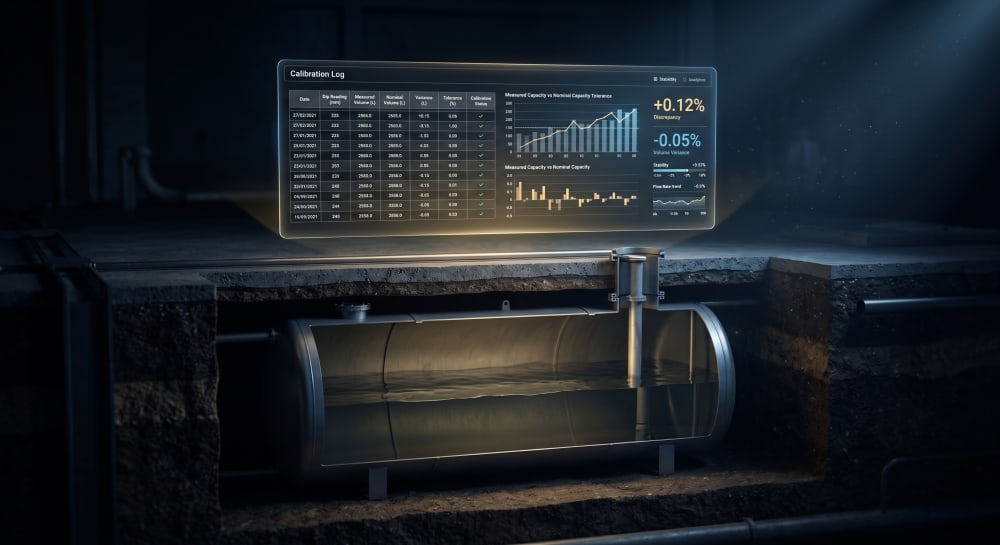
A Simple Calibration Log for Underground Tanks (And Why It's Not Just Paperwork)
Underground tank calibration isn't a formality. It's a licensed regulatory requirement, and most stations aren't tracking it the way they should.

September 20, 2026
Calibration of underground storage tanks isn't really a "nice-to-have" record-keeping habit. Under NMDPRA's Oil & Gas Industry Service Permit guidelines, calibrating underground storage tanks at retail outlets is its own licensed service category. Before a station is even licensed to operate, a regulator must witness the tank's pressure and leak test while it's being buried.
Given that, it's worth asking yourself honestly: after that first certificate, is anyone actually still tracking calibration over time at your station? In my experience, quite a few operators only have the one record from installation, and nothing since. Not because anyone's being careless. It's just not the kind of thing that naturally gets written down again once the station is up and running.
What a Calibration Log Actually Needs
Nothing complicated. Just enough to answer one question clearly: when was this tank last checked, and what did they find?
| Tank | Product | Date Calibrated | Measured Capacity | Nominal Capacity | Discrepancy | Corrective Action | Next Due |
|---|---|---|---|---|---|---|---|
| Tank 1 | PMS | ||||||
| Tank 2 | AGO | ||||||
| Tank 3 | DPK |
That's genuinely it. Seven columns. You can build this in five minutes in Excel or Google Sheets, or even on paper if that's what your station already uses day to day. The format matters less than the habit of actually filling it in every time.
A few notes on the columns that might not be obvious at first glance. "Measured Capacity" versus "Nominal Capacity" is the whole point of calibration. Nominal is what the tank was built to hold. Measured is what it actually holds, checked physically. Over years underground, those two numbers can drift apart, and that drift is exactly what you're trying to catch early. "Corrective Action" doesn't need much detail either. Even a line like "no action needed, within tolerance" is a real, useful entry. The goal is a continuous record, not a perfect one.
Why This Small Habit Matters More Than It Looks
When a regulator or auditor asks for calibration history, you want to hand over a sheet, not go searching through an old filing cabinet for a certificate from years ago. And if a tank's readings start drifting between calibrations, a log like this is what actually lets you notice the pattern in time, instead of only finding out when a shortage shows up during reconciliation and nobody can explain where it came from.
If you already keep something like this at your station, I'd genuinely like to know what it looks like for you. Paper file, spreadsheet, something else entirely. It'll tell me what to write about next.
// Comments (0)
Log in or register to join the discussion.
// No comments yet. Start the conversation.