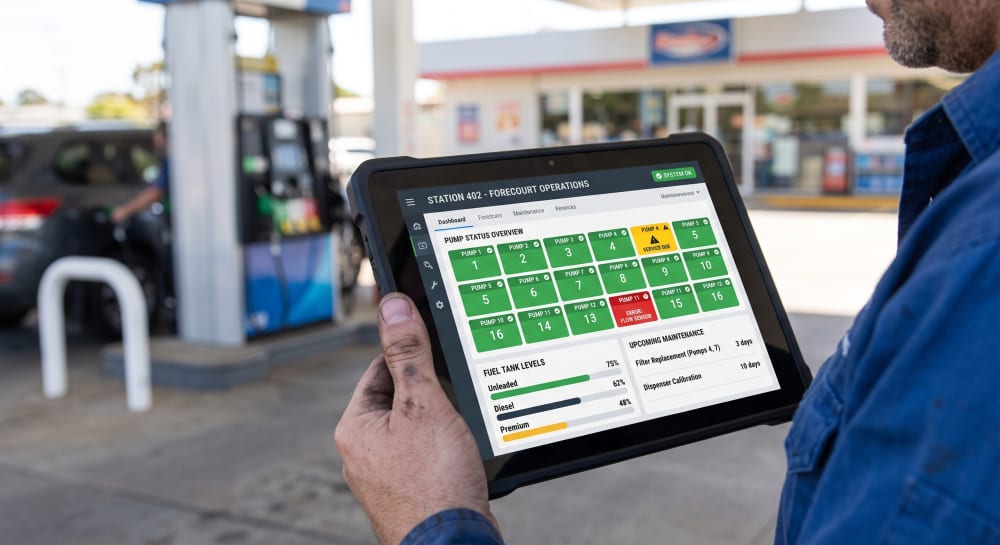
Why Fuel Stations Still Run Maintenance on WhatsApp and Spreadsheets
A look at why most downstream fuel retail networks still track maintenance on WhatsApp and spreadsheets, and what actually breaks when they do.

August 22, 2026
Walk into the back office of most fuel stations in Nigeria, and you'll find the same setup: a shared Excel file nobody quite trusts, a WhatsApp group where station managers report faults, and a station manager who remembers half the maintenance history in their head because it was never written down anywhere else. This isn't a criticism; it's just the honest starting point for almost every downstream operator I've worked with or spoken to. The real question worth asking is why, when comparing a CMMS vs spreadsheet for maintenance tracking, so many networks still default to the spreadsheet.
I've spent years on the maintenance side of this industry, calibrating tanks, chasing dispenser faults, keeping HSE logs current. So this isn't theory. It's the gap I watched every single week.
The Spreadsheet Isn't the Problem. What Happens Around It Is.
A spreadsheet is a perfectly fine tool for a single person tracking a single list. The trouble starts the moment more than one person needs to touch it:
- Nothing enforces consistency. A database table links an equipment record to its maintenance log by an ID, not by someone typing the same name correctly twice. A spreadsheet has no such rule. "Pump 3," "pump three," and "Dispenser 3 – Pump" can all exist in the same sheet referring to the same thing, and nothing catches it. Your filter, your VLOOKUP, your pivot table, all of them are only as reliable as everyone's typing discipline, forever.
- History gets thin. A dispenser fault gets logged as a WhatsApp message, gets resolved, and the conversation scrolls away. Six months later, when the same dispenser fails again, nobody remembers it's the third time.
- Nothing reminds anyone of anything. Preventive maintenance, the entire point of avoiding downtime, depends on someone remembering to check the spreadsheet on the right day. Usually, they don't, until something breaks.
- Compliance becomes reconstruction. When an HSE audit or an NMDPR inspection asks for a maintenance history, someone spends two days piecing it together from chat logs and memory instead of pulling a report.
None of this is a people problem. It's a tooling problem. The people doing this work are often excellent at their jobs; the tool just isn't built to hold what they need it to hold.
Why Operators Don't Just "Get a CMMS"
If the problem is this obvious, why hasn't it already been solved with off-the-shelf software? A few honest reasons:
Most CMMS platforms are built for factories, not forecourts. The big names in this space, the tools that show up when you search "best CMMS," are priced and designed around plants with dozens of complex assets and dedicated reliability teams. A network running a handful of stations doesn't map cleanly onto that pricing or that workflow.
Setup cost competes with the fire it's meant to prevent. When the day-to-day is already stretched thin, a multi-week software rollout feels like a luxury, even when the long-term math clearly favors it.
Nobody's shown the smaller, honest version of this yet. Most content about CMMS software is written by vendors selling enterprise contracts, for readers who already have a maintenance department. Almost nothing is written for someone running two or three stations who just needs their maintenance history to stop living in a group chat.
What This Actually Costs
The spreadsheet-and-WhatsApp approach isn't free; it's just costed differently. It shows up as:
- Repeat failures on equipment that had a known, undocumented history
- Slower HSE and regulatory audits
- Maintenance decisions made from memory instead of data
- No clean way to see whether a station's downtime is improving or getting worse over time
None of these show up as a single line item anywhere. They just quietly compound.
Where This Series Is Headed
Over the next few weeks, I'm going to work through this problem the way I'd actually approach it as an engineer: starting with the smallest useful piece of software, not the biggest one. Next up, I'm building a maintenance tracker from scratch in Flask, the exact stack I use for projects like this, and walking through it step by step, starting with the data model.
If you run maintenance for a downstream retail network, even a small one, I'd like to know: is this still how your team tracks things, or have you already moved off spreadsheets? Drop a comment; I read all of them.
// Comments (2)
Log in or register to join the discussion.
Insightful!!!
Thank you Sonofthesun. I am glad you found it insightful.