The Invisible Layer of Inventory Loss: Why Tank Cleaning Is a Data Integrity Issue
We invest heavily in automated tank gauges and reconciliation software, but there's a physical layer beneath it all that most operators overlook.

September 30, 2026
In downstream energy retail, a lot of money goes into digital forecourt controllers, automated tank gauges, and reconciliation software. Everyone wants clean, precise, instant data. But there's a basic fact that gets forgotten in all of that: you cannot get clean data out of a dirty tank.
Recently, I have been working through a full degassing and cleaning protocol on PMS and AGO underground storage tanks. To someone watching from the outside, this looks like straightforward, dirty maintenance work, necessary for environmental compliance and nothing more. But if you actually think about what the tank does in the system, cleaning it is a data calibration exercise, not just a chore.
Why the Physical Layer Matters to the Numbers
Underground tanks accumulate sludge, sediment, and microbial growth at the bottom over time. That buildup physically displaces fuel volume. If a tank has a few inches of dense sludge sitting at the bottom, both a manual dipstick reading and an automated tank gauge probe are working against a tank chart that no longer reflects what's actually down there. You end up calibrating daily inventory against a nominal capacity that stopped being accurate a while ago.
That sludge doesn't just clog dispenser filters eventually. It quietly creates a gap between what your systems say you have and what's physically there, the kind of gap that shows up as an unexplained inventory loss at the end of the month, with nobody quite able to say where it went.
What This Actually Looked Like on Site
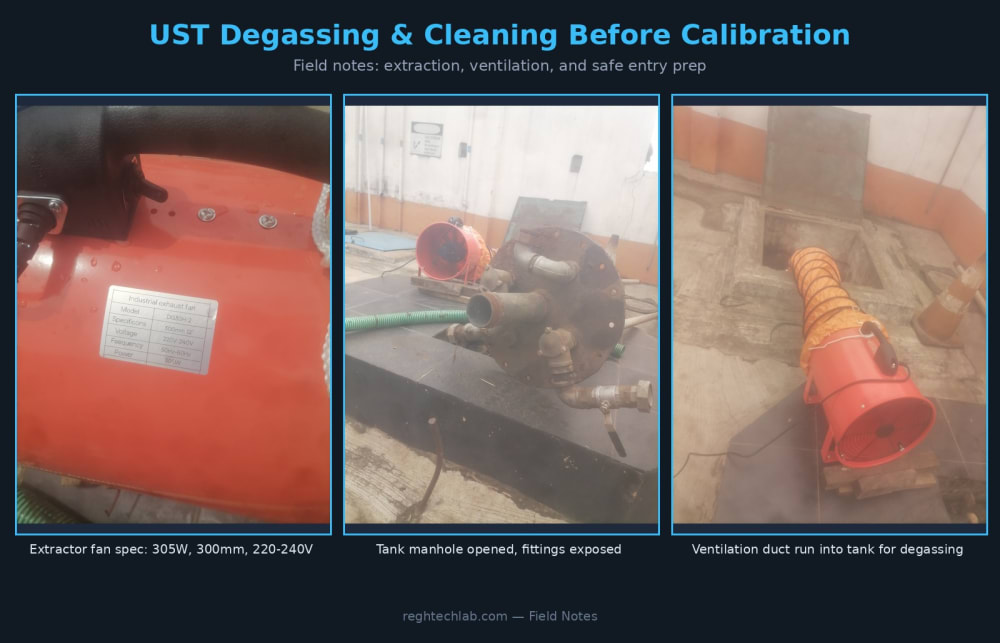
The tank was ventilated before anyone touched the manhole for entry. Vapor lingers in an underground tank, and oxygen levels in a confined space like that can be dangerous on their own, even before flammable vapor enters the picture. We ran an industrial extractor rated at 305W, 300mm, 220 to 240V, ducted straight down into the tank, and kept it running continuously, not just for a few minutes before entry but for as long as anyone was actually working inside after degassing the tank.
Only once that was properly done did the manhole and fittings get exposed and cleaning actually begin.
Where This Connects to Calibration
I wrote about calibration logs a couple of weeks ago. A simple calibration log for underground tanks and why it's not just paperwork. This is the step that has to happen before that log entry means anything. A calibration reading taken against a tank still carrying sludge at the bottom isn't a small inaccuracy; it's a number quietly built on a tank chart that no longer matches reality.
Software can only be as reliable as the physical condition of what it's measuring. Linking maintenance schedules, things like mandatory degassing and sludge removal, directly to how volume reconciliation gets interpreted stops treating operations and accounting as two separate worlds answering to two different realities. Clean tanks produce data you can actually trust. And data you can trust is what protects your margins in the first place.
Most writing about downstream operations skips straight to the numbers. I think the physical work that makes those numbers honest deserves just as much attention as the numbers themselves.
// Comments (0)
Log in or register to join the discussion.
// No comments yet. Start the conversation.